
Can a house with mold be saved? Almost always. Mold remediation removes the material that can't be cleaned, such as soaked drywall and insulation, and keeps the framing, the concrete and the structure.
What decides whether it works is not how bad the mold looks. It is whether the water that fed it gets fixed.
This guide covers what decides it, which materials can be cleaned and which have to go, how a moldy house is actually brought back, and whether it is safe to stay while that happens. For the full process, see our mold remediation service.
Material guidance from the EPA's Water Damage: Cleanup and Mold Prevention and Mold Remediation Guidelines tables (Mold Remediation in Schools and Commercial Buildings, 2008).
What Decides Whether a House Can Be Saved
Mold rarely ruins a house on its own. It ruins the materials it grows into, and those are mostly the cheap, replaceable layers: drywall, insulation, carpet pad, ceiling tiles. Four things decide how big the job is.
- Whether the moisture source can be fixed. A burst supply line is fixed in an hour. A roof leak, a sweating AC duct or a bathroom fan venting into the attic needs that trade first. Until the source is fixed, any remediation is temporary.
- How long things stayed wet. The EPA's guideline is to dry water-damaged materials within 24 to 48 hours to prevent mold growth. Past that, more material has to come out rather than being dried in place.
- What kind of water it was. The EPA's tables are for clean water. Where water is contaminated with sewage or other pollutants, they say protective equipment and containment are required, and more porous material is usually lost.
- Whether the structure is sound. Mold on framing is usually a cleaning job. Wood that has gone soft from a long leak is a carpentry repair, and we'll tell you when we see it.
Notice what isn't on the list: the color of the mold, or whether someone called it black mold. The CDC says all molds should be treated the same way for removal. Our guide to common types of household mold explains why the type changes less than people expect.
What Can Be Saved, Material by Material
The EPA's remediation guidelines sort materials by how they are cleaned. Hard and non-porous materials can be cleaned; porous ones that mold has grown into generally can't, once the patch is more than small.
| Material | Usually | How, per the EPA's guidelines |
|---|---|---|
| Wood framing, studs, subfloor | Saved if sound | Wet vacuum, damp wipe, HEPA vacuum once dry; removal on large jobs where needed |
| Concrete or block walls | Saved | Wet vacuum and HEPA vacuum once dry |
| Tile, vinyl, metal, plastic | Saved | Vacuum or damp wipe with water and mild detergent; check that the underfloor is dry |
| Drywall | Replaced, unless a small patch | HEPA vacuum on small areas; on larger areas, remove and discard |
| Insulation and ceiling tiles | Replaced | Wet fiberglass and cellulose insulation and ceiling tiles: discard and replace |
| Carpet and pad | Depends | Can be dried if caught within 24 to 48 hours; moldy carpet is often discarded |
Wood gets its own guide, because it is where people most often assume the worst: see mold remediation on wood. Staining that stays on clean, dry, sound framing is cosmetic. For carpet, our guide to drying wet carpet covers when it can be saved.
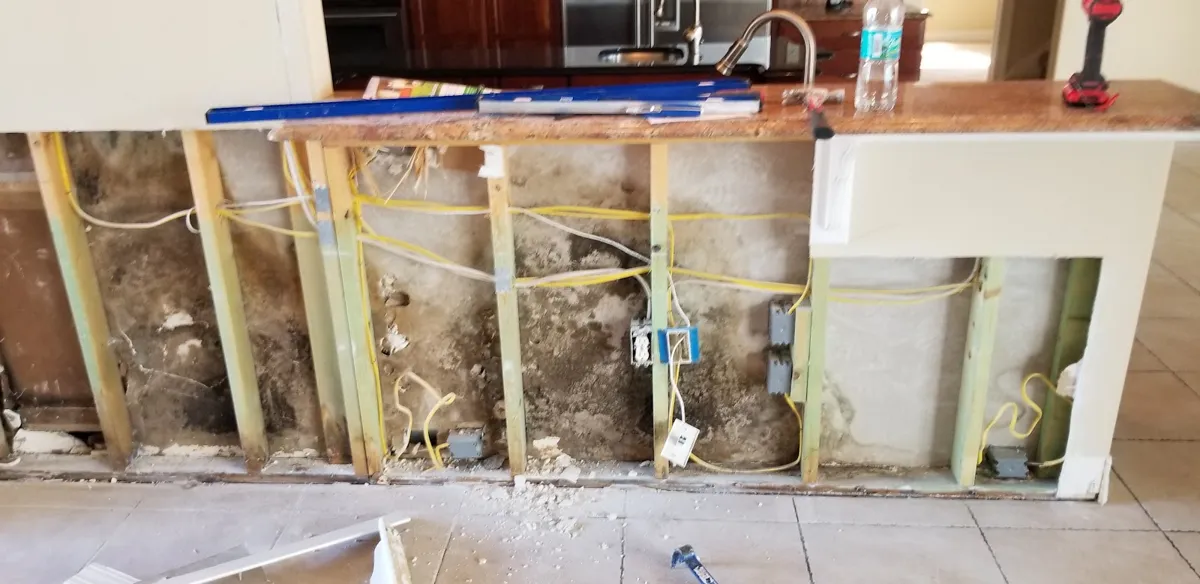
How a House With Mold Gets Saved
Every job we do follows the same order, because each step depends on the one before it.
- Find the moisture. We trace it with moisture meters and a thermal camera before anything is opened up, so we know how far the water spread, not just where the mold shows.
- Fix or stop the source, or tell you which trade has to: plumber, roofer or AC technician.
- Contain the area. Plastic containment and negative air keep spores from spreading through the rest of the house while work is under way.
- Remove what can't be cleaned. Moldy drywall, insulation and pad come out and are bagged. Framing and structure stay.
- Clean and filter. Framing and hard surfaces are cleaned and HEPA-vacuumed, HEPA filtration runs during and after removal, and surfaces are treated with antimicrobial.
- Dry the structure. Our TES (Thermal Energy System) drives controlled high heat into the wet area, with daily moisture readings until it reads dry, not just dry to the touch.
Only then does anything get closed back up. The most common reason mold comes back is a wall rebuilt over framing that was still wet, and a reading on a meter is what prevents it.
Florida Block Homes
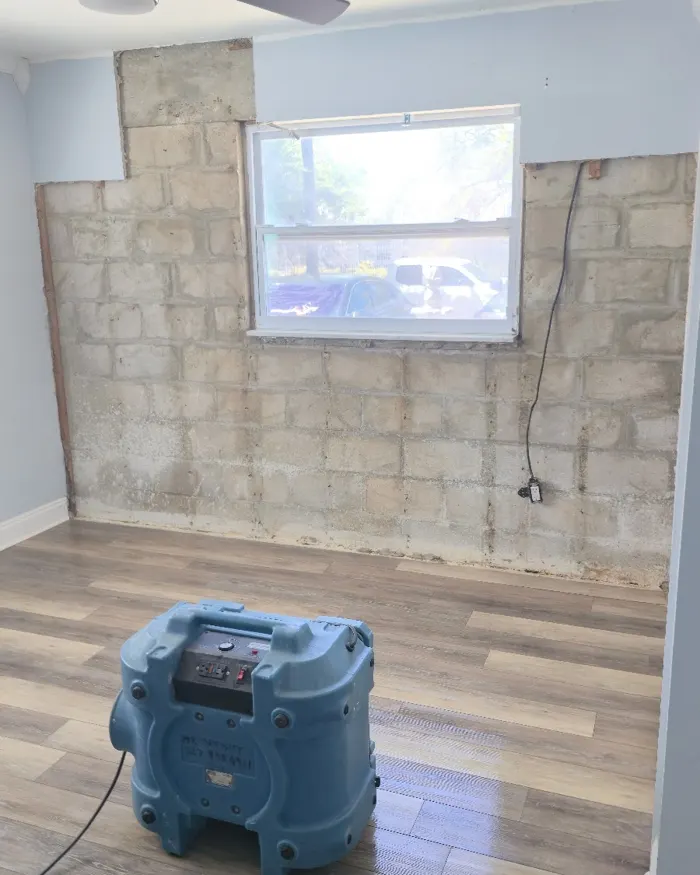
Many Florida homes, like the one in the photo below, have concrete block walls behind the drywall. That helps. Block doesn't feed mold the way paper-faced drywall does, and the EPA treats it as a material to clean and dry, not replace. When the drywall comes off a block wall, what's left behind can be cleaned, dried and closed up again.
The catch is drying time. Block holds water, and the drywall and baseboard on its face can stay damp long after the room feels dry. That's why we measure, rather than run fans for a few days and hope.
Is It Okay to Stay in a House With Mold?
It depends on the people more than the house. The CDC says people with asthma or mold allergies may have severe reactions, and people with weakened immune systems or chronic lung disease may get lung infections from mold. The EPA says people with asthma should avoid exposure to molds. If anyone at home is in those groups, or you have health concerns, the Florida Department of Health's advice is to consult your doctor.
Containment exists so the rest of the house isn't exposed while the work is under way, and whether staying makes sense depends on who lives there and where the mold is. If the mold is in the AC system, the Florida Department of Health says the system should ideally be shut down while it is cleaned, which in a Florida summer can change the answer. We'll tell you what the containment covers and what it doesn't. For what the health agencies say about symptoms, see our guide to the warning signs of mold toxicity.
How Do You Test for Mold in Your House?
For visible mold, you usually don't need to. The CDC does not recommend mold testing, and the Florida Department of Health says sampling is not needed in most cases when mold is visible. An independent assessment earns its fee when the mold is hidden, when you are buying or selling, or when an insurance claim needs a clear scope. In Florida, assessors and remediators are licensed separately, and the assessment is a separate job from the fix.
Insurance and Cost
Whether insurance pays depends on where the water came from. Mold from a sudden, covered water loss such as a burst pipe or an appliance leak is often covered, while mold from long-term humidity or a slow leak is usually excluded. When it is covered, we document everything and bill the claim directly. Our guide to does insurance cover water damage goes through how Florida policies treat it, and mold remediation cost covers the price when you are paying yourself.
Florida law treats mold work over 10 square feet as remediation that needs a licensed company when someone does it for you; under that, our DIY mold remediation guide shows how to handle it yourself.
Mr. Dry Out is licensed by the Florida Department of Business and Professional Regulation to remediate mold and handles the water side too, so one crew does the drying and the mold. We work out of Hudson across Zephyrhills, Lutz, Dade City, New Port Richey, Clearwater and the rest of Tampa Bay. See our mold remediation service, or call us any time.
Can a House With Mold Be Saved? FAQ
Usually, yes. Even widespread mold is mostly in porous, replaceable material such as drywall and insulation. Those come out; the framing, concrete and hard surfaces are cleaned and dried. What matters most is fixing the moisture source and confirming the structure is dry before rebuilding.
It depends on who lives there. The CDC says people with asthma or mold allergies may have severe reactions, and the EPA says people with asthma should avoid exposure to molds. If you have health concerns, the Florida Department of Health advises consulting your doctor.
For visible mold you usually don't need to. The CDC does not recommend mold testing, and Florida's health department says sampling isn't needed in most cases when mold is visible. For hidden mold, a sale or a claim, hire a licensed mold assessor, which in Florida is a separate job from remediation.
Not when the moisture is fixed and the structure is dried before it is closed up. Most mold that returns was cleaned off a surface while the leak, condensation or wet material behind it stayed in place.
Rarely. Mold remediation removes the material mold has grown into and keeps the structure. Wood that has rotted from a long leak needs repair, and that is a construction decision, but mold alone is seldom a reason to demolish.
Often, when the mold came from a sudden, covered water loss like a burst pipe or appliance leak. Mold from long-term humidity or a slow leak is usually excluded. We document everything and bill the claim directly when it is covered.